
Clinker Quality Parameters: How C3S and Free Lime Dictate Cement Strength and Grinding Energy in African Mills
A deep technical analysis on balancing Tricalcium Silicate (C3S) and Free Calcium Oxide (Free Lime) to optimize 28-day compressive strength and reduce specific electrical power consumption (kWh/t) in ball and VRM cement grinding units.
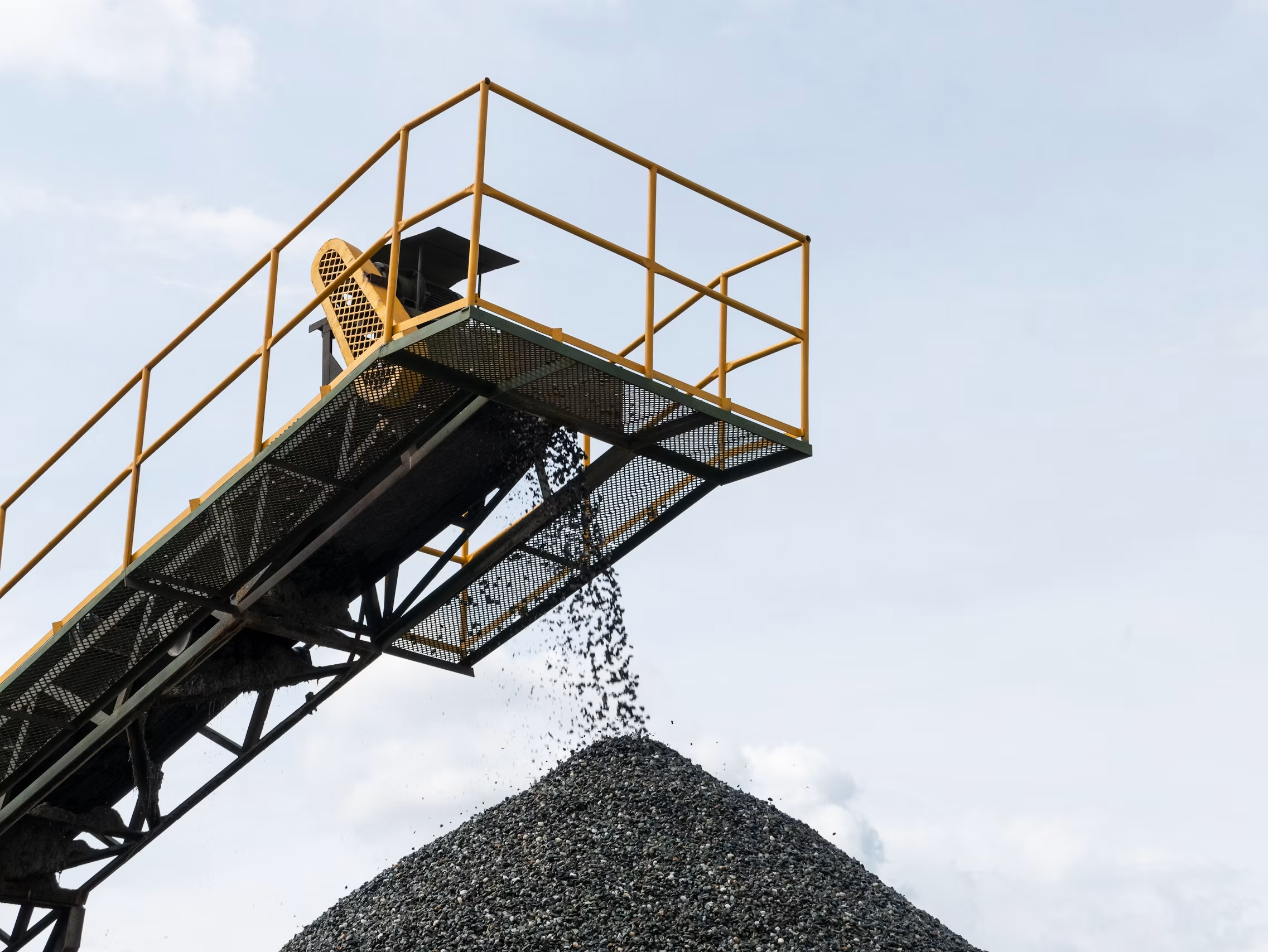
The Economics of Clinker Reactivity in Independent Grinding Units
In the African cement manufacturing landscape, grinding-only plants represent over 60% of modern capacity additions. For plant managers and procurement heads, clinker purchase represents between 68% and 78% of total operational expenditure.
Selecting clinker purely on a per-ton CFR price often results in severe hidden production costs: increased ball mill power consumption, elevated gypsum demand, or the inability to meet national standards (such as KS EAS 18-1 or TZS 727) for 28-day compressive strength without excessive fine grinding.
---
Key Mineralogical Phases & Their Direct Operational Impact
Clinker quality is governed by four primary Bogue mineral phases, each playing an exacting role in hydration dynamics:
1. Tricalcium Silicate ($C_3S$ / Alite - 55% to 65%) - Role: The primary driver of early strength (2 to 7 days) and ultimate 28-day hydraulic strength. - Target Range: For high-performance cement (CEM I 42.5N/R), $C_3S$ must exceed 58.0%. Clinker with $C_3S < 54%$ forces mills to grind to higher Blaine fineness ($>380 ext{ m}^2/ ext{kg}$), consuming up to 8–12 additional kWh per metric ton.
2. Dicalcium Silicate ($C_2S$ / Belite - 12% to 20%) - Role: Slow-reacting phase contributing to 90-day and 1-year ultimate matrix density. - Optimal Balance: Higher $C_2S$ provides lower heat of hydration (ideal for mass concrete), but requires strict mineralizer control during kiln sintering.
3. Tricalcium Aluminate ($C_3A$ - 7% to 11%) - Role: Flash-setting phase requiring gypsum ($CaSO_4 cdot 2H_2O$) addition to control setting time. - African Market Note: For coastal civil marine works (Mombasa, Dar es Salaam, Beira), moderate $C_3A$ ($<8%$) is preferred to prevent ettringite expansion and sulfate deterioration.
4. Free Calcium Oxide ($ ext{Free } CaO$ - Target $< 1.20%$) - Significance: Uncombined lime resulting from incomplete sintering or coarse limestone feed. - The Danger of High Free Lime ($>1.8%$): Free lime hydrates slowly into $Ca(OH)_2$ with volumetric expansion, causing unsoundness and micro-cracking in hardened concrete. Furthermore, high free lime signifies poorly burnt, unreactive clinker with erratic liter weight.
---
Sourcing Provenance Comparison for East & Southern Africa
| Sourcing Origin | Typical $C_3S$ (%) | Free Lime (%) | Liter Weight (g/L) | Typical Voyage to Mombasa | Moisture Risk | | :--- | :--- | :--- | :--- | :--- | :--- | | Turkey (Marmara/Med) | 60.0 – 64.0% | 0.80 – 1.10% | 1,240 – 1,320 | 12–15 Days | Very Low | | Egypt (Red Sea) | 58.0 – 62.0% | 0.90 – 1.30% | 1,220 – 1,290 | 7–10 Days | Low | | UAE (Fujairah/RAK) | 59.0 – 63.5% | 0.85 – 1.20% | 1,250 – 1,330 | 8–11 Days | Low | | Vietnam (Nghi Son) | 56.0 – 60.0% | 1.10 – 1.50% | 1,180 – 1,260 | 16–20 Days | Moderate (Monsoon dependent) |
---
Procurement Checklist for Clinker Cargo Delivery
To safeguard production integrity, ensure your commercial contract mandates: - Pre-shipment SGS sampling with Composite XRF and Bogue analysis attached to original Bill of Lading. - Continuous liter weight tracking during loading ($>1,180 ext{ g/L}$ floor threshold). - Maximum moisture cap of 0.50% at discharge port to prevent pre-hydration and warehouse setting.
Need Specific Technical Formulations for Your Kiln?
Our engineering team analyzes your plant raw meal stoichiometry and coal burner configurations to match optimal origin lots.